
But will they keep?
On living creatively right where you are

When I was fifteen, I participated in a British Literature class in a drafty room with second-grade art projects bedazzling the walls. I remember two things most clearly: (i) that my friend sketched dragons onto every homework paper, and (ii) a conversation we had while reading Jane Eyre.
We were three-quarters of the way through the book. Jane had just been offered a position as a schoolteacher in Morton: a dreary, quiet town in the northern moors of England. The job is “humble” and “plodding,” though not “ignoble” or “mentally degrading.”
“I thank you for the proposal, Mr. Rivers, and I accept it with all my heart.”
“But you comprehend me?” he said. “It is a village school: your scholars will be only poor girls—cottagers’ children—at the best, farmers’ daughters. Knitting, sewing, reading, writing, ciphering, will be all you have to teach. What will you do with your accomplishments? What, with the largest portion of your mind—sentiments—tastes?”
“Save them till they are wanted. They will keep.”1
Our teacher, a kind woman with far too many things to do, leaned against her desk. “I liked that line—‘they will keep.’ There’s something humble about it. So many people now are only willing to do things that suit them, exactly—but here Jane just says, ‘I know I won’t be able to use my accomplishments. It’s fine. They will keep.’”
I remember sitting at my table, dotted with sharpie stains and glue smudges, too troubled even to pay attention to the fire-breathing dragon studiously coming into existence beside me. My own studies—this class included—were taking more and more time. My love for telling stories was one I was jealously guarding.
Was it prideful, not wanting to let it go?
That question has stuck in the back of my mind ever since. How was I supposed to interpret that line? Was Jane right, after all?
Recently, I was perusing a shelf (not my own) and found a copy of Edith Schaeffer’s The Hidden Art of Homemaking: Creative Ideas for Enriching Everyday Life. Intrigued by her personal history2, I decided to borrow it.
If anyone’s looking for a new nonfiction read, I heartily recommend it. The basic premise is that, as God is a creative being and humanity is made in his image, the redeemed ought to be more creative than other people.
But—and here’s the catch—it need not be monetized to be creative.
We often limit our understanding of creativity to people who do it as a career: actors or musicians or novelists or whatnot. We talk about “creative people” and “non-creative people,” which is terrible wording—because, again, creativity is a mark of divine-patterning.
Instead, creativity ought to be threaded into every area of life. It takes creativity to grow bluebells across a tin roof, to tell stories to your children, to play the piano, to come up with interesting and beautiful meals, to dress tastefully.
Schaeffer drives home the point, repeatedly, that we are all creative—but not all of us act like it. When life makes us work with spreadsheets rather than oils and easels, or when we find ourselves surrounded by oft-fussy children instead of on stage, we throw up our hands and give up on our creativity.
And that is a very dangerous thing to do indeed.
Suppressing the particular talents God has given you is not, in fact, holier than nurturing them. He may not call you to monetize it or make it a career, yes. But they are still given—to create beauty, to reflect his image, to bless those around you. And as the parable of the talents (what a fitting word!) reminds us, we are given things to use them.
You do not need a large audience for a talent to be “worth it.” Your friends are enough; your own family is more than enough reason to be intentionally creative in how you walk in God’s image.
Doing so keeps your own soul satisfied—for suppressed creativity makes cranks of the best of us—and sows beauty at the same time.
The world is a far, far better place for all the creative people working as accountants, on construction crews, raising children, and serving as hotel clerks. The creation of beauty is far too important a task to assign to only a certain category of individuals. It is, in many different expressions, a calling for all of us.
Jane Eyre, then, was partially right and partially wrong.
She did not need to teach at a first-class boarding school or sip tea in high society. It was perfectly all right for her to take a humble job in a humble town amongst humble people.
Yet her “accomplishments”—those ways of expressing her own creativity—were not bound to high society. The faithfulness of the artist trumps the size of the audience, every time.
It was at her humble job, in her humble town, amongst her humble students, that Jane was called to be creative.
And it is you, right now—in the daily hum-drummities of your life, as you drive down highways, sweep floors, ring up customers, or speak with tiring neighbors—that you are called to be creative.
Whatever it is, nurture that spark where you come alive: be it playing music, arranging flowers, cooking beautiful meals, reading books aloud, or what-have-you. God’s design for you is not threatened by the seeming smallness of your surroundings.
The attention will keep. The calling to creativity will not.
Enjoyments here and there:
Music: “Jupiter, Bringer of Jollity” by Gustav Holst. It’s currently my favorite piece of classical music, and if you look it up, you’ll find out why.
Poetry: I’ve been dipping deeper into Mary Oliver’s work, and it’s delightful. “Invitation” is one of my favorites—just to be alive / on this fresh morning / in this broken world. https://readalittlepoetry.com/2023/12/24/invitation-by-mary-oliver/
Fiction: I finally got my hands on Words of Radiance, the second book in Brandon Sanderson’s Stormlight Archives, and my impressively-patient friend has received many all-caps screeches at the various plot twists.
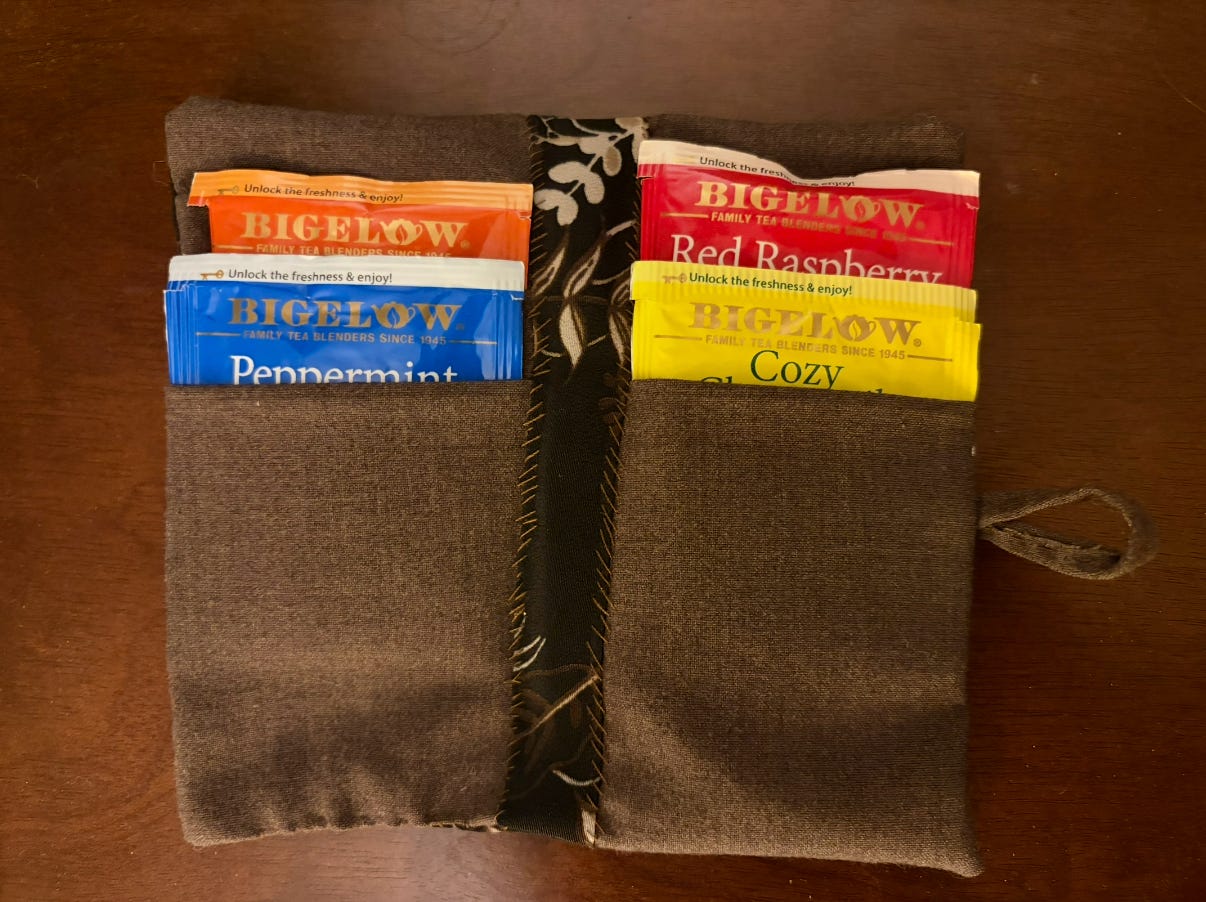
Crafting: I made a “tea wallet” so as always to have Emotional Support Tea easily on hand. I took my sewing with me when I worked at the “pioneer land” at our county fair, and it was grand to walk around in pioneer garb guessing at lengths because I’d not brought a measuring tape.
Brontë, Charlotte; Jane Eyre
Edith and her husband, Francis Schaeffer, were the founders of the first L’Abri in Switzerland in 1955. https://labri.org/history/
I don't think I've ever read all of Jane Eyre, so I don't know what all her accomplishments were, but my first thought on her response was wondering if it was true she really wouldn't use them. His list of things she'll be doing sounds like a challenge! I've been seeking to grow in creativity at home, though I hadn't thought of wording it that way. Two books to add to my ought to read list! Thanks for the post.
Oh, the tea wallet is splendid!
This has made me think and encouraged me, friend. Thank you.